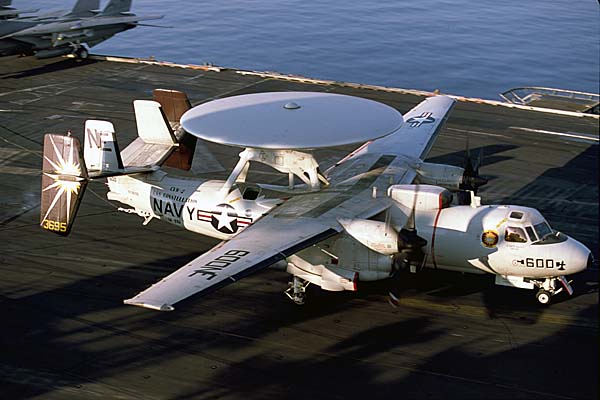
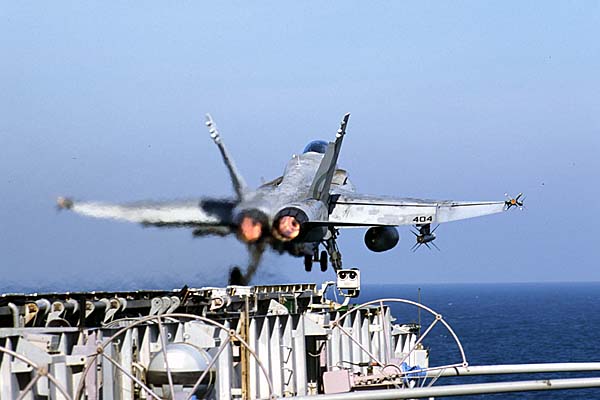
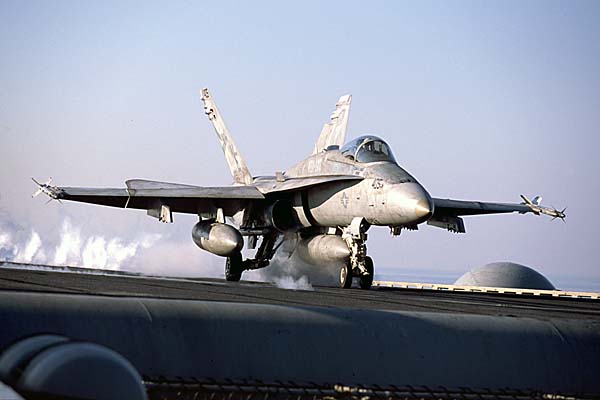
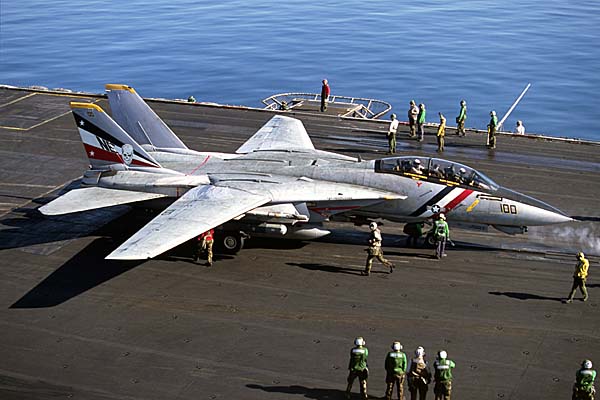
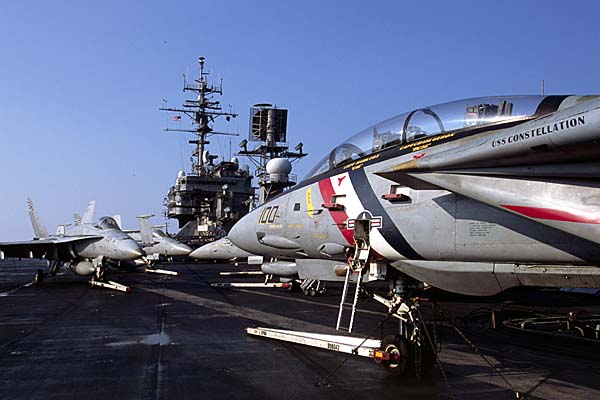
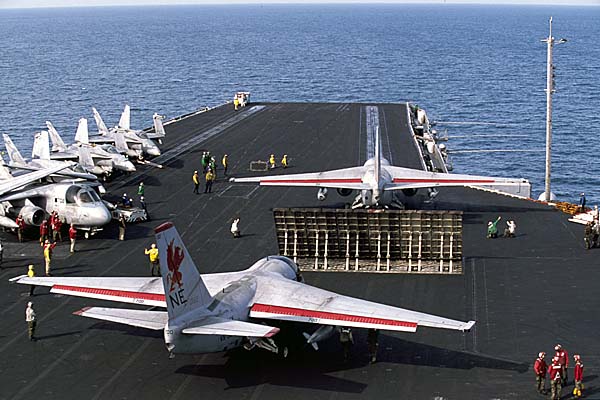
88,000 Tons of diplomacy is currently sailing in the Persian Gulf and the Arabian Sea in the form of the USS Constellation (CV-64). Ready to go to war with Iraq or any other aggressor when needed. If diplomacy fails, the aircraft carrier will transform into a awesome amount of airpower. With its 72 aircraft from Carrier Air Wing TWO embarked, this aircraft carrier is most probably making its last cruise. Connie's last ride is called "Sunset Cruise 2002-03".
This might very well be the last time the ship is going to be part of a war. With Iraq not being very co-operative with the UN weapons-inspectors and the continuing violence of no-fly zones, shooting at
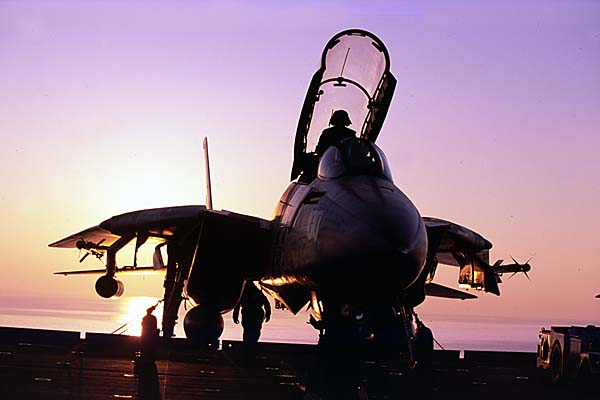 unmanned Predator and manned US/UK aircraft, Iraq is constantly exploring how far it can go. The USS Constellation is scheduled to be decommissioned in the autumn of 2003 but off course this can be postponed if opereations require. CVN-76 Ronald Reagan is planned to replace the Connie. It wouldn't be the first carrier that has to extend its regular six Month deployment because the president asks for it. If the vessel will be decommissioned this year it will become part of the Navy reserve fleet for another ten years before actually being scrapped. Being part of the Navy reserve fleet means that if needed the carrier can return to active service in a short period of time.
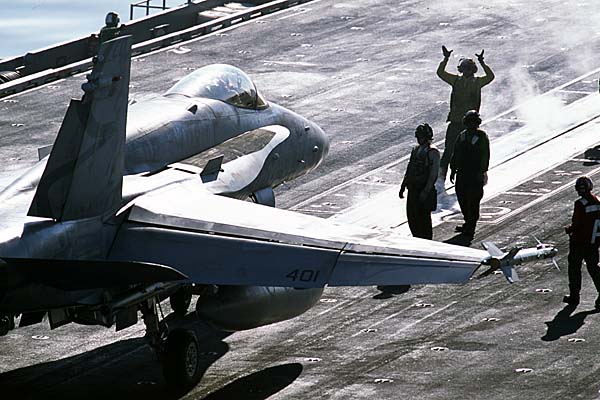 Like her famous namesakes, USS Constellation has a proud and distinguished record. Connie, as her crew affectionally calls her, has over 41 years of service, which has seen her sail into harm's way from Yankee Station off the coast of Vietnam to the turbulent waters of the Arabian Gulf. Just like the original Constellation, America's newest and best Navy ship was immediately put to the test. In response to North Vietnamese attacks on U.S. destroyers in the Gulf of Tonkin in August 1964, Constellation departed from a scheduled port visit to Hong Kong and was the first U.S. warship to launch strikes against North Vietnamese vessels and bases.
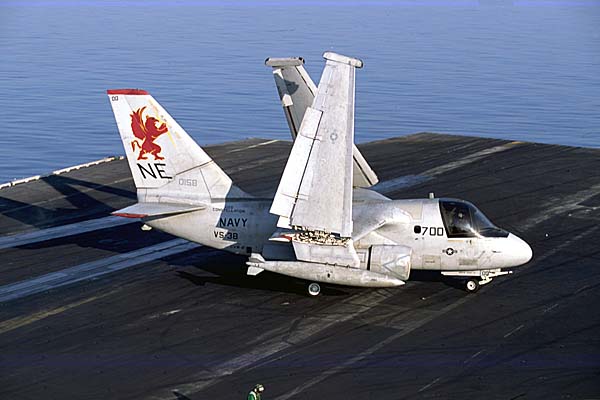
Over the next eight years, Constellation would return to the South China Sea for a total of seven combat cruises, conducting air strikes against heavily fortified North Vietnamese positions, engaging naval targets and shooting down enemy aircraft. In November 1968 pilots from the Constellation flew the last strike missions into North Vietnam prior to a bombing halt declaration. In May 1972, Lt Randy Cunningham en Ltj.g. Willie Driscoll of Fighter Attack Squadron 96 became Amercia's first fighter aces of the Vietnam War by downing three MiGs during vicious dogfighting over North Vietnam.
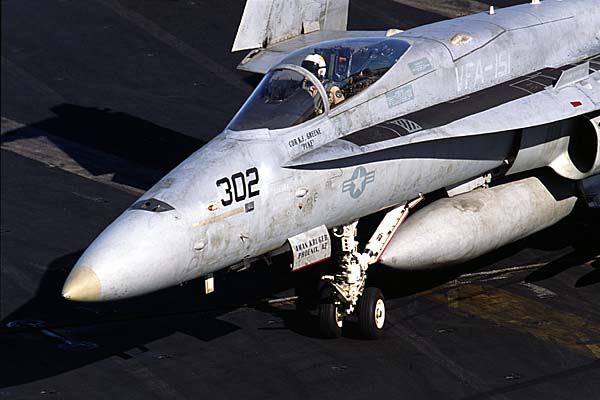 In 1975 Connie was re-designated "CV" from "CVA" following a complex overhaul to the flight deck, enabling her to deploy with the S-3A Viking and F-14 Tomcat aircraft. A newly refurbished Connie began her 10th deployment in April 1977. In September 1978, during her 11th overseas deployment, the ship's cruise was extended because of the Iranian hostage crisis. A new record was set on her 12th deployment to the Western Pacific and Indian Oceans when Connie remained on station for 110 consecutive days.
In 1982, Constellation returned to the yards, this time in Bremerton, Washington. Naval aviation had undergone vast changes since 1961, and when Connie came out of the yards in 1984 it was completely modernized. One facet of the ship's upgrade was the ability to carry
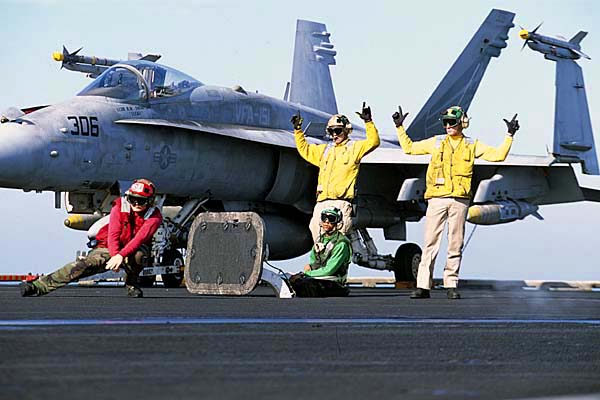
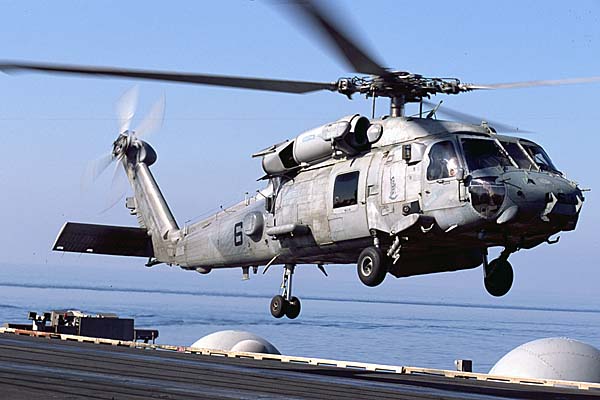 the Navy's newest strike fighter, the F/A-18 Hornet. She was also, and still is, fitted with the PHALANX radar-guided gattling gun, a NATO Sea Sparrow Missile System and two new flush deck catapults. During WestPac 1987,
Constellation once again found itself in the spotlight; this time providing vital air cover for the U.S. flagged oil tankers through the Arabian Gulf. In February 1990, Connie left San Diego, her homeport since its commissioning, returning to the East Coast for a three-year overhaul and Service Life Extension Program (SLEP) which added an estimated 15 years to the carrier's operational life. The overhaul saw upgrades to virtually every system on the ship.
the Navy's newest strike fighter, the F/A-18 Hornet. She was also, and still is, fitted with the PHALANX radar-guided gattling gun, a NATO Sea Sparrow Missile System and two new flush deck catapults. During WestPac 1987,
Constellation once again found itself in the spotlight; this time providing vital air cover for the U.S. flagged oil tankers through the Arabian Gulf. In February 1990, Connie left San Diego, her homeport since its commissioning, returning to the East Coast for a three-year overhaul and Service Life Extension Program (SLEP) which added an estimated 15 years to the carrier's operational life. The overhaul saw upgrades to virtually every system on the ship.
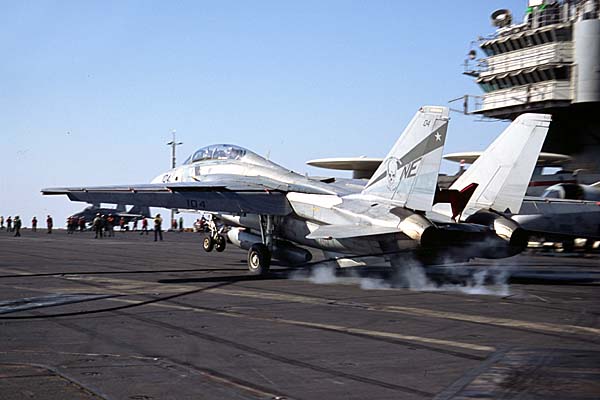 More then 8,000 Pacific Fleet sailors commenced a six-month deployment in support of Operation Enduring Freedom when Naval forces of the USS Constellation (CV 64) Carrier Battle Group departed San Diego on November 2, 2002. This so-called "WestPac" or Western Pacific deployment describes the scheduled six-month period of overseas operations of a carrier and its battle group. Contradictionary to previous yeras, Connie prepared for and turned around in a 13-month cycle, rather than the routine 18 month period between deployments. Events of September 11, 2001 shifted ship's schedules and thus moved Constellation's deployment period to the fall of 2002. The battle group's preparations for this deployment included a Composite Unit Training Exercise (COMPTUEX) and a Joint Task Force Exercise (JTFEX)
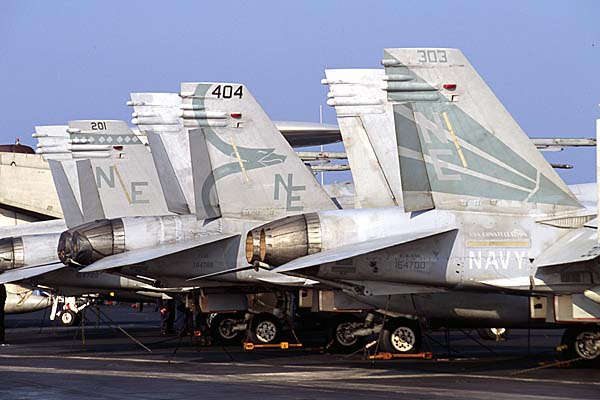
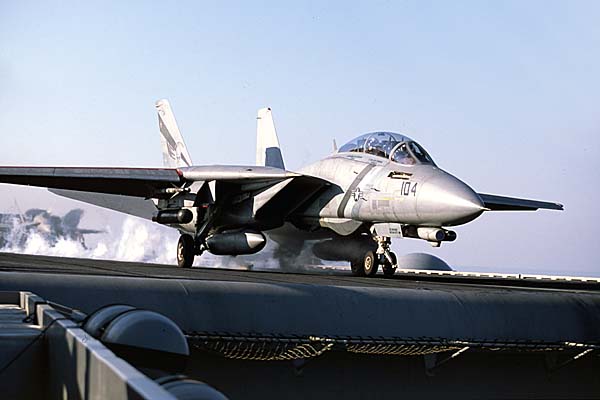 off the coast of Southern California between October 17 and 29, 2002. The exercise tested the force's ability to respond to operational scenarios they might encounter during the deployment, which will be the 21st (and last) deployment for the 41-year old Constellation. Aircraft carriers like the Constellation are deployed worldwide in support of U.S. interests and commitments. They can respond to global crisis in ways ranging from peacetime presence to full-scale wa. Together with their on-board air wing, the carriers have a vital roles across the full spectrum of conflict. Biggest tool for the Constellation to perform its tasks is off course the Air Wing embarked on the ship. The task are originally described as follows:
 * To provide a credible, sustainable independent forward presence and conventional deterrence in peacetime
* To operate as the cornerstone of joint/allied maritime expeditionary forces in times of crisis and,
* To operate and support aircraft attacks on enemies, protect friendly forces and engage in sustained independent operations in war.
Carrier Aiw Wing TWO, with its 72 aircraft, is responsible for the amount of airpower on board the Constellation. The air wing is the carrier's primary offensive and defensive weapon of an aircraft carrier, allowing it to dominate the air space surrounding the ship and to project its awesome poswer ashore. The air wing brings together nearly 2,600 officers and enlisted men and women, maintaining and flying the 72 sophisticated airplanes
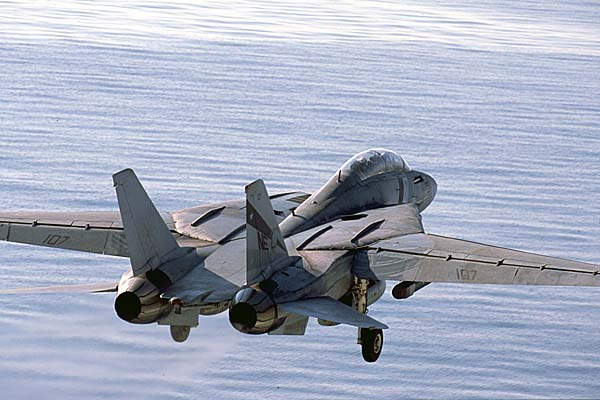 and helicopters. Although the Air Wing has a long and interesting history, 1 April 1997, 18 June 1999, 16 March 2001 and 2 November 2002 marked the beginnings of Western Pacific and Arabian Gulf deployments for CVW-2 and the Constellation. Throughout these more then 20 months of combined deployed time, CVW-2 has successfully conducted a total of over 40 weeks of high tempo operations in the Arabian Gulf, including more then 15,000 sorties while in the Fifth Fleet's Area of Responsibility (AOR). Operations during the last deployments have included joint-combined exercises with Saudi Arabian, Qatari, Kuwait and Bahrain defence forces. In addition to flying training missions, CVW-2 has flown over 4,000 sorties in support of Operation Southern Watch, enforcing the no-fly zone over Southern Iraq.
Commanding Officer of Carrier Air Wing TWO is Captain Mark I. Fox, 46, a Desert Storm veteran who is confident that no matter the mission, his team will execute it to perfection.
and helicopters. Although the Air Wing has a long and interesting history, 1 April 1997, 18 June 1999, 16 March 2001 and 2 November 2002 marked the beginnings of Western Pacific and Arabian Gulf deployments for CVW-2 and the Constellation. Throughout these more then 20 months of combined deployed time, CVW-2 has successfully conducted a total of over 40 weeks of high tempo operations in the Arabian Gulf, including more then 15,000 sorties while in the Fifth Fleet's Area of Responsibility (AOR). Operations during the last deployments have included joint-combined exercises with Saudi Arabian, Qatari, Kuwait and Bahrain defence forces. In addition to flying training missions, CVW-2 has flown over 4,000 sorties in support of Operation Southern Watch, enforcing the no-fly zone over Southern Iraq.
Commanding Officer of Carrier Air Wing TWO is Captain Mark I. Fox, 46, a Desert Storm veteran who is confident that no matter the mission, his team will execute it to perfection.
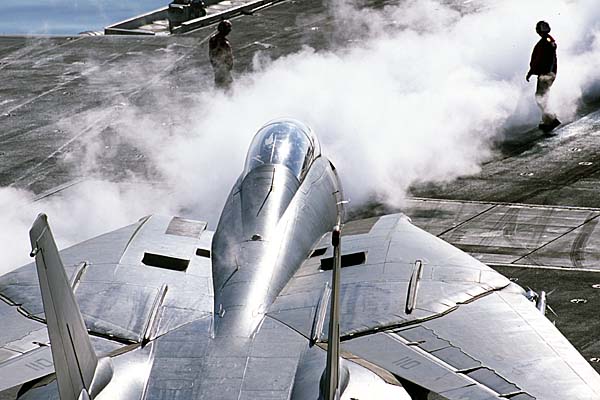 "We will do it safely and professionally". Captain Fox scored the first Navy MiG kill of the Gulf War moments prior to delivering his bombs on a Western Iraqi airfield on January 17, 1991. Captain Fox led four major airwing strikes and flew 18 combat sorties during the conflict. He has logged 4,200 mishap-free flight hours and over 1,200 arrested landings on 13 different carriers. "Desert Storm is ancient history," acoording to Captain Fox. There have been incredible advance in precision guided weapons since the beginning of that war. We were talking about how many sorties we needed to destroy a target, now we are talking 'bout how many targets one plane can destroy.
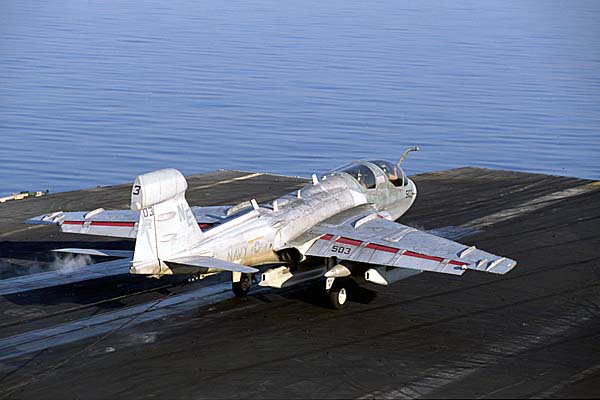 "I think it is important to note that carrier air power has been the key factor in our efforts in the region. Regardless of the path the War on Terror takes, I am confident that carrier air power will continue to be decisive and the Connie will play a major role" says Captain John W. Miller, commanding Officer of the USS Constellation. Designated a Naval Flight Officer in June 1980 he received orders to VF-101 for replacement training in the F-14A Tomcat. During his career he has logged more then 3,500 flight hours and 1,000 arrested landings in the Tomcat. He is boosting the morale of his fellow sailors by a daily television show and through the intercom system on the ship.Everywhere on the ship, morale is boosted with American flags with all kinds of greetings on it,
 drawings from children etcetera. "We will never forget 09-11-01" is another sentence seen everywhere on the ship and on many aircraft and helicopters as well. Talk to any sailor, pilot, cook or chaplain on board and he will tell you that they are ready to go to war. They have trained hard, are a long way from home and relatives but willing to go to war if necessary. It may seem amazing for an outsider to hear that even a port visit during its stay in the 5th fleet AOR is not something a lot of people look forward to. "If you are out at sea and away from home for such a long time, it is sometimes better not to see any land before returning home. That way you are not reminded of what you are missing".
 With the USS Constellation and its battle Group currently on station in the 5th Fleet AOR, they are awaiting the arrival of more Carrier Battle Groups in the area in order to start a war if Saddam Hussein will not comply to all UN resolutions soon. The USS Harry S. Truman (CVN 75) in the Mediterranean is ready to deploy to the 5th Fleet AOR as well. The USS Abraham Lincoln (CVN 72) was almost home after a six month deployment last December but was ordered to remain on deployment near Australia, while the USS Kittyhawk (CV 63) was also ordered to prepare for deployment to the 5th Fleet AOR. The USS Theodore Roosevelt (CVN 71) is gearing up for deployment in the next 6 weeks while USS George Washington (CVN 73) is on alert for possible deployment. This last carrier arrived in Norfolk on December 20 last year but allready returned to sea off the Atlantic coast to start carrier qualifications. Besides the carrier battle groups there are a couple of Amphibious Assault Ships en route to the region as well. One of these, the USS Nassau (LHA-4) is already on station. This incredible
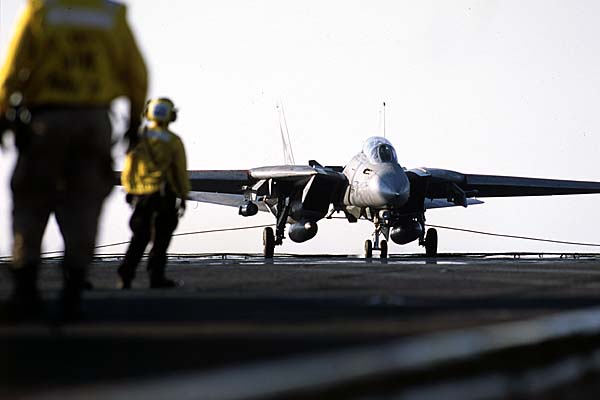 and awesome amount of airpower should convince every sensible thinking human being to come down a peg or two!!
The Constellation Battle Group (CBG) is composed of several different commands, all which reside under the authority of Rear Admiral Barry M. Costello, Commander Carrier-Destroyer Group ONE (CCDG-1). USS Constellation, often referred to by its hull number (CV-64), is the centerpiece of the battle group. Carrier Air Wing TWO (CVW-2), is made up of eight Navy squadrons and one Marine Corps squadron. The other ships and submarines in the battle group are under the command of Commander Destroyer Squadron SEVEN (DESRON 7).
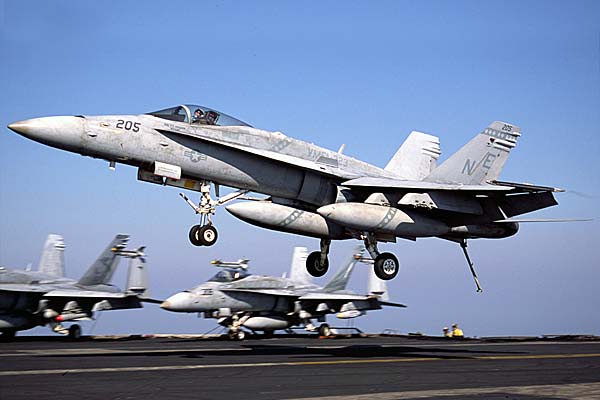 Carrier Air Wing TWO's motto, "For Liberty, We Fight" is appropriate for a military organization that has served the cause of liberty since the end of World War II. Established in May 1945 as CVBG-74, the new "Battle Air Group" originally comprised 96 F4U/FG-1D Corsairs and 46 SBW-4E Helldivers. Redesignated CVBG-1 on 15 November 1946, the first true deployment took the Air Group to the Mediterranean Sea from October 1947 to March 1948. Renamed CVG-2 in 1948, the Air Group saw action during the Korean War. The first of seven combat deployments to Southeast Asia began in 1965. Air Wing TWO was credited with the first three confirmed MiG-17 kills over North Vietnam. CVW-2 began a long affiliation with USS Ranger (CVA-61) during the 1967-68 deployment. A lot of deployments during the years are responsible for an impressive row of records and events in which CVW-2 took part. To name just a few: North Korea's seizure of USS Pueblo (AGER-2), introduction of Laser-Guided Bombs (LGB) to Navy operations in Vietnam, Operation Desert Shield, Operation Desert Storm, Operation Southern Watch, Operation Restore Hope, Operation Deny Flight, Operation Decisive Edge and at this moment Operation Enduring Freedom.

 USS CONSTELLATION
 Brooklyn, New York. Equipped with eight boilers and four geared steam turbines which produce 280,000 shaft horsepower. The four shafts give the carrier a 30+ knots speed.